











HISTORIE PAARDEN
MODERNE PAARDEN:
Domestic horses were introduced into
Babylonia in about 2000 BC and into Egypt about 300 years later.
The animals were brought into Egypt by the Hyksos from
northeastern Syria. These Egyptian and Babylonian horses were the
forerunners of the swift Arabian and related desert breeds of the
Middle East and northern Africa. Another strain of horses was
domesticated in Europe. Heavily built and slower but more
powerful than the desert breeds, they are regarded as the early
ancestors of the modern draft horses used for plowing, pulling
wagons, and other heavy work. Some authorities also believe that
a third ancestral strain found in the British Isles was the
prototype of various breeds of modern ponies.
 Throughout most of Europe,
from the early centuries AD to about the 17th century, the
powerful native horses were used for military mounts, for hauling
heavy loads, and as pack animals. During the same period the Arab
world had developed smaller, fast-galloping breeds, which were
introduced into Spain after the Muslim conquest in the 8th
century. The horses bred in Spain became famous for their speed
and endurance and many were imported into England and Europe as
early as the 12th century. Systematic attempts to improve extant
breeds of horses, however, did not take place until the end of
the 17th century, when Arabian stallions were imported to England
and France to breed with mares of native stock.
Throughout most of Europe,
from the early centuries AD to about the 17th century, the
powerful native horses were used for military mounts, for hauling
heavy loads, and as pack animals. During the same period the Arab
world had developed smaller, fast-galloping breeds, which were
introduced into Spain after the Muslim conquest in the 8th
century. The horses bred in Spain became famous for their speed
and endurance and many were imported into England and Europe as
early as the 12th century. Systematic attempts to improve extant
breeds of horses, however, did not take place until the end of
the 17th century, when Arabian stallions were imported to England
and France to breed with mares of native stock.
The first domestic horses introduced into the Americas were of
the Arabian type, brought by the Spanish conquistadores and
explorers in the 16th century. They are believed to have lost or
abandoned some of their horses, and these animals may have been
the source of herds of wild horses found in various parts of
western North America. Horses left by the Spanish also ran wild
on the pampas of South America around the Río de la Plata. The
English settlers, especially the early Virginia colonists, also
imported horses.
In the last 300 years horse breeders have made continuous
attempts to improve the various breeds of horses and to develop
strains that are particularly suited for specialized tasks. The
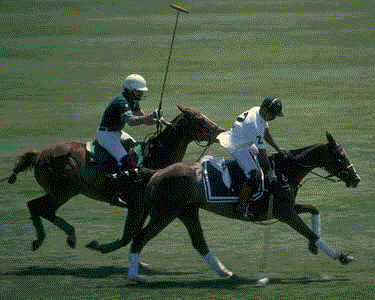
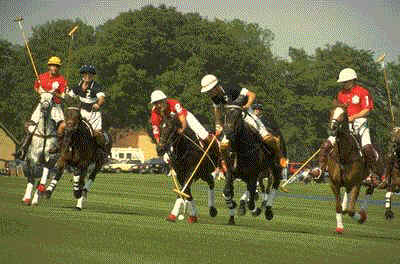
resultant new breeds include saddle horses and harness horses
especially adapted for racing gaits, hunters adapted for
endurance, carriage horses and draft horses for pulling heavy
loads, and cattle horses, ponies, and polo ponies (small, fast
animals that can be trained to the complicated maneuvers of
roping or the game of polo).
The Arabian breed is often divided into three subbreeds: Turks
from European Turkey and Asia Minor, Arabians from the regions
between Damascus and the Euphrates River, and Barbs from the
Barbary states of northern Africa. Arabians in general are
comparatively small horses, standing between 147 and 152 cm (58
and 60 in) at the withers (the high part of the back, located
between the shoulder blades), or 15 hands high. The height of a
horse is frequently given in hands, one hand-the width of a human
hand-is equal to 10 cm (4 in). Arabians have remarkable powers of
endurance and are swift gallopers. All the saddle breeds are
derived, in large part, from Arabian stock.
The Thoroughbred was developed in the early 18th century from
offspring of three foundation sires-the Byerly Turk, the Darley
Arabian, and the Godolphin Barb-and native English mares. It is
primarily used for flat-track racing, hunting, and jumping. The
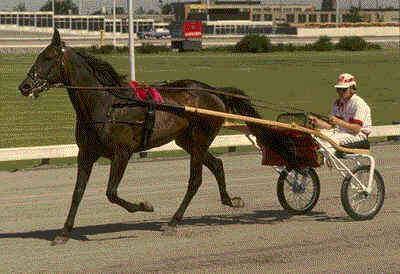
American standardbred, developed in the northeastern United
States in colonial times, is a light harness type and is most
often used in trotting or pacing races. Biologically speaking,
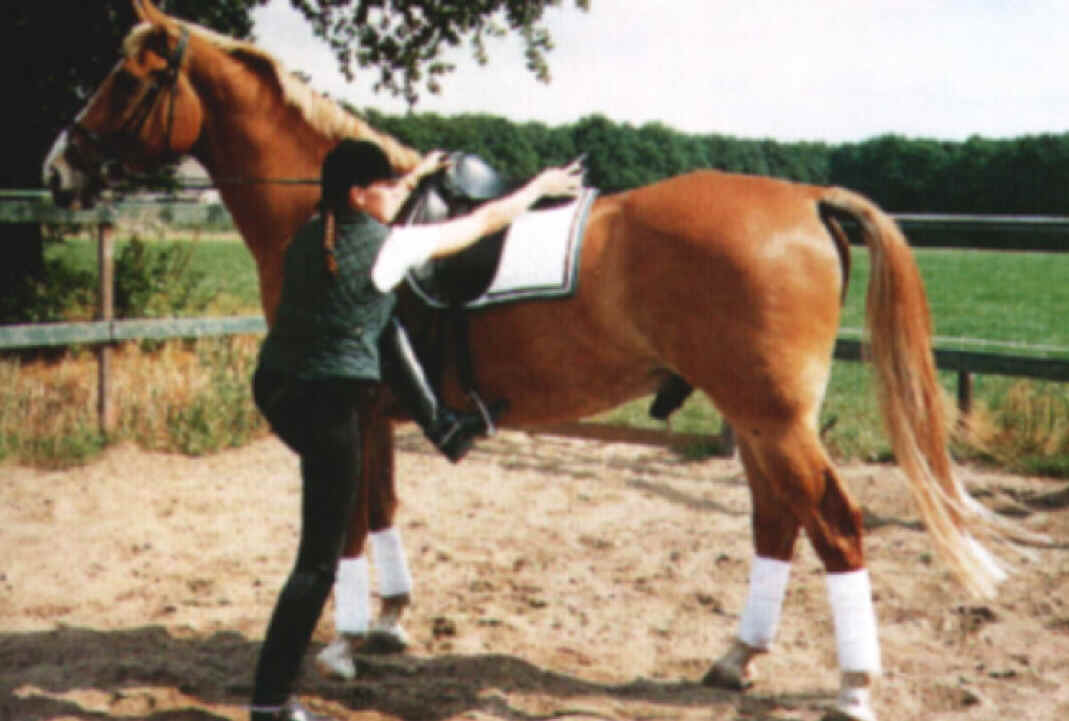
saddle horses are more properly types than breeds. Because of the
popularity of various equestrian sports and activities, registry
and breed associations have been established for such important
show and racing horses as the American saddle horse, the
Tennessee walker, the Morgan, and the quarter horse. Saddle
horses weigh much less than draft horses.
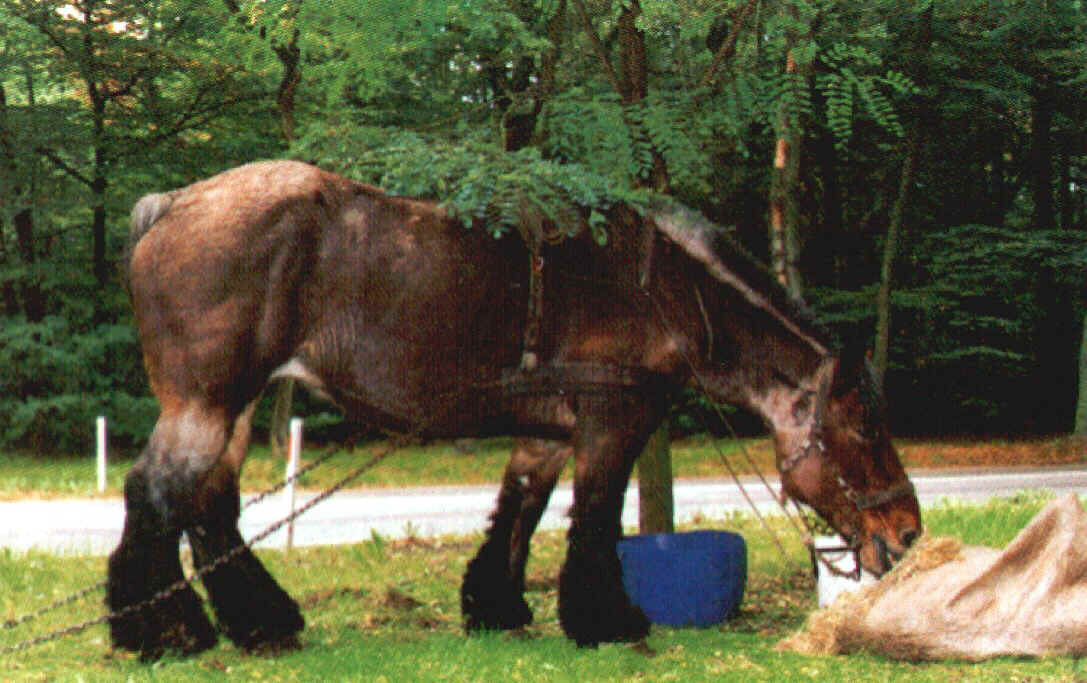
The breeds of draft horses are more distinct than those of saddle
horses. They include the Belgian heavy draft  horse, the English shire,
the Clydesdale, and the Percheron. The Belgian is one of the
largest of horses, reaching a shoulder height of 173 cm (68 in)
or more and weights of as much as 1125 kg (2500 lb). The English
shire is about the same size, but has long hair on the back of
its hind legs from its hooves up to the hock (a joint
corresponding to the human ankle, but bending backwards). These
breeds represent refinements of the original horses of their
countries of origin. The Clydesdale, smaller than the above
breeds, was developed in Scotland by crossing native horses with
Belgian heavy draft horses and the English shire. The Percheron,
which stands about 168 cm (66 in) at the shoulder, is a native of
the former district of Le Perche in northwestern France and was
produced by crossing Arabian horses with the old Flemish breed of
which the Belgian heavy draft horse is the modern representative.
horse, the English shire,
the Clydesdale, and the Percheron. The Belgian is one of the
largest of horses, reaching a shoulder height of 173 cm (68 in)
or more and weights of as much as 1125 kg (2500 lb). The English
shire is about the same size, but has long hair on the back of
its hind legs from its hooves up to the hock (a joint
corresponding to the human ankle, but bending backwards). These
breeds represent refinements of the original horses of their
countries of origin. The Clydesdale, smaller than the above
breeds, was developed in Scotland by crossing native horses with
Belgian heavy draft horses and the English shire. The Percheron,
which stands about 168 cm (66 in) at the shoulder, is a native of
the former district of Le Perche in northwestern France and was
produced by crossing Arabian horses with the old Flemish breed of
which the Belgian heavy draft horse is the modern representative.
Ponies are identified as those breeds which stand less than 152
cm (60 in) or 15 hands high. The real differences between ponies
and larger horses, however, are size and action. The body of a
pony is deeper in relation to its height than that of a horse,
and a pony usually is more sure-footed than a horse. Many ponies
are native to Great Britain: the Dartmoor, the Exmoor, and the
Welsh mountain pony for instance. The smallest of the ponies is
the Shetland, which is only about 106 cm (about 42 in) high at
the withers.
Scientific classification: Horses belong to the family Equidae of
the order Perissodactyla. The domestic horse is classified as
Equus caballus. Przewalski's wild horse is classified as Equus
caballus przewalskii.
Horse, common name for hoofed,
herbivorous mammals that include the domestic horse and three
groups of undomesticated species. One group comprises the zebra,
native to Africa; another consists of the ass, including the
kiang and onager of Asia and the wild ass of Africa. The third
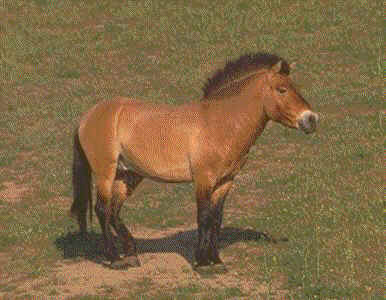
group contains Przewalski's wild horse, which is now found only
in captivity. The only extant true wild horse, it produces
fertile offspring when crossed with the domestic horse. Other
so-called wild horses in various parts of the world, such as the
mustang in North America, are descendants of domestic horses that
have reverted to a wild state.
Modern Horses
The most marked anatomical characteristic of the modern horse is
the possession of a single toe on each of its four feet, which
makes it a perissodactyl, or odd-toed ungulate, along with the
rhinoceros and tapir. The horse's toe, which corresponds to the
middle digit of the human hand, is much enlarged and protected by
a horny hoof that surrounds the front and sides of the toe.
Vestigial splints corresponding to the second and fourth toes are
situated on either side of the foot above the hoof.
The skull of the horse is long; the facial bones are twice the
length of the cranium. The mandible, or lower jaw, is long and
has a broad, flat plate at its lower hind end. The spine is
composed of 7 cervical, 18 dorsal, 6 lumbar, 5 sacral, and 15
caudal vertebrae. Horses have 44 teeth: 3 incisors, 1 canine, 4
premolars, and 3 molars on each side of each jaw. The incisors,
which are used for cropping grass and other herbage, grow in the
form of a semicircle. A pronounced gap exists between the canine
teeth and the premolars; the metal bit used for controlling a
horse is placed in this gap when the animal is ridden or driven.
All the teeth have long crowns and comparatively short roots. The
horse has a simple stomach, and fermentation of fibrous food
takes place in a blind pocket, or cecum, analogous to the
appendix in humans. It is located at the juncture of the small
and large intestines. In a large horse the cecum may have a
capacity of about 38 liters (about 10 gallons).
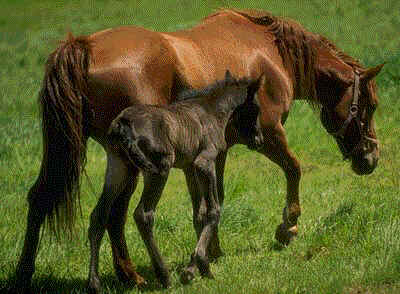
Both male and female horses are sexually mature by the age of
two. They are seldom used for breeding purposes, however, before
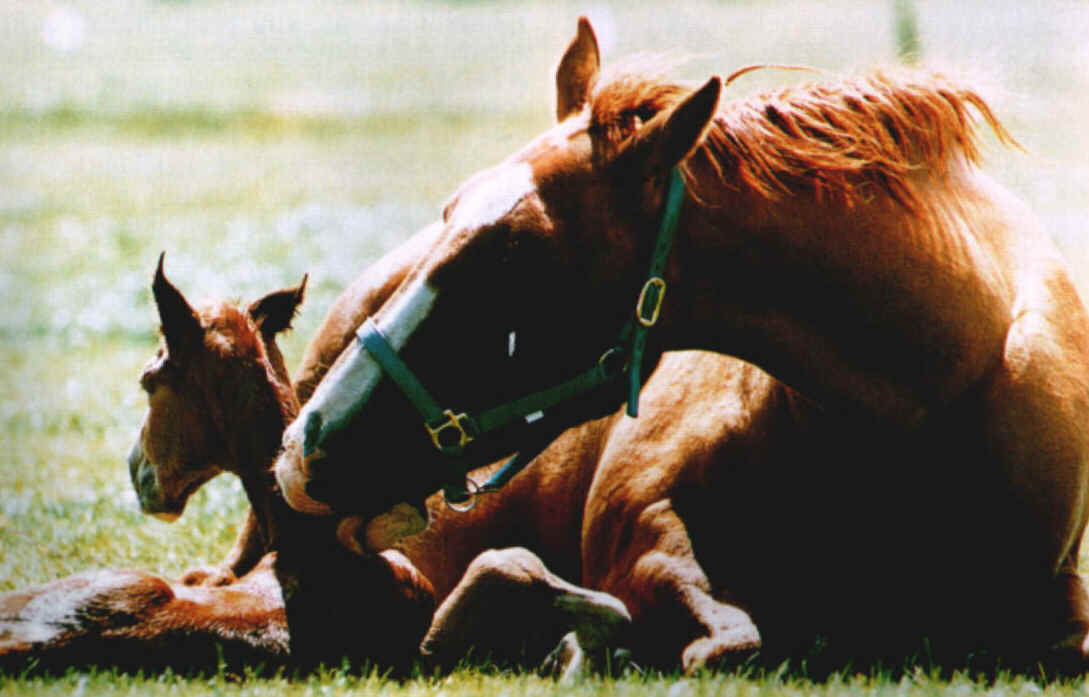
they are three years old. The gestation period is about 11
months, and single births are the rule. Twins are a genuine
rarity, and only a few births of three or more foals have ever
been recorded.
PRÉHISTORIE - GANGEN - MODERNE PAARDEN